
The "Morning Height" Phenomenon
Why You’re Taller in the Morning
And How to Keep That Height Permanent
Date Published: April 25, 2026 | Time to Read: 5-6 Minutes
The Mystery of the Missing Inch
Have you ever adjusted your car’s rearview mirror in the morning, only to find it’s “too high” by the time you drive home from work? Or perhaps you’ve measured yourself after waking up and found you are nearly a full inch taller than you were the night before?
This isn’t a measurement error. It is a biological reality. Every day, the average human “shrinks” by 1.5 to 2.5 centimeters. By understanding why this happens, we can unlock the secret to maintaining a taller, more decompressed stature throughout the entire day.
The Anatomy of the Intervertebral Disc
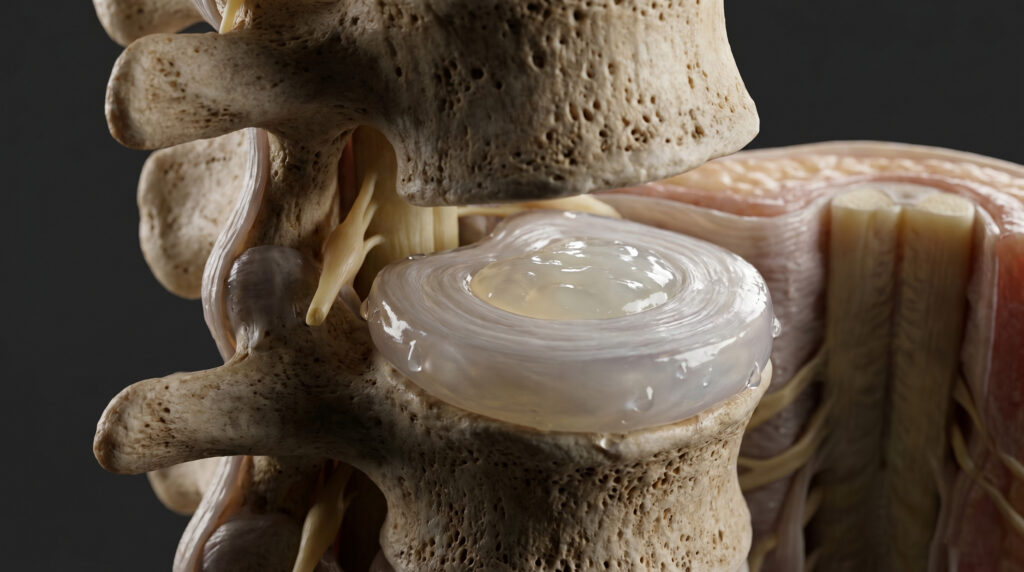
The human spine consists of 24 movable vertebrae, separated by intervertebral discs. Think of these discs as the “shock absorbers” of your body. They are made of a tough outer layer and a jelly-like center called the nucleus pulposus, which is roughly 80% water.
When you stand and move during the day, gravity exerts constant downward pressure on your spine. This pressure slowly “squeezes” the fluid out of these discs a process known as Diurnal Fluid Loss. By the end of the day, your discs are thinner, your spine is shorter, and your connective tissues are more compressed.

Why Sleep Isn’t Enough?
While you sleep, the lack of vertical gravitational load allows your discs to undergo Imbibition, a process where they soak up fluid from the surrounding tissue and “inflate” back to their original size. This is why you wake up at your maximum biological height.
However, for most people, this is a losing battle.
The Problem: Within just 2 to 3 hours of standing up, gravity has already reclaimed most of that “morning height.”
The Cumulative Effect: Over years of this cycle, the connective tissues around the spine become stiff and lose their ability to fully rehydrate, leading to permanent height loss as we age.
Shifting from "Temporary" to "Permanent"
The goal of height optimization isn’t just to enjoy an extra inch for the first hour of your day. It is to increase the baseline thickness of the disc space and the elasticity of the surrounding ligaments.
By applying specific mechanical tension, we can train the connective tissues to resist gravitational collapse and encourage the discs to maintain a higher state of hydration for longer periods. We aren’t just “straightening” the spine; we are physically expanding the vertical capacity of the skeletal suspension system.
Engineering Permanent Decompression
To keep your morning height, we have to address two physical properties of your connective tissue: Creep and Hysteresis.
Creep: This is the tendency of a solid material to move slowly or deform permanently under the influence of persistent mechanical stresses. By applying a specific, controlled tension, we encourage the “creep” to happen in a vertical direction, slowly lengthening the resting state of your ligaments.
Hysteresis: This refers to the “lag” in how tissue returns to its original shape after being stretched. When you use a professional system to decompress, you are extending that lag time, allowing your body to stay taller for longer periods during the day until eventually, the “stretched” state becomes the new normal.
How CorHeight Fixes the "Gravity Problem"
Sleep is a passive process. You lie down, and your discs rehydrate naturally. CorHeight takes this biological process and makes it active and targeted.
Instead of just waiting for the discs to soak up fluid overnight, CorHeight uses mechanical tension to “pull” the vertebrae apart more effectively than simple lying down can. This creates a negative pressure vacuum (Intradiscal Pressure reduction) within the disc.
Enhanced Suction: This vacuum pulls nutrients and fluid into the disc center (the nucleus) much faster and more deeply than sleep alone.
Ligamentous Set: By stretching the surrounding ligaments while the discs are “inflated,” CorHeight helps “set” the spine in an elongated position.
The Result: You aren’t just waking up taller; you are building a structural frame that is more resilient to the downward “squeeze” of gravity throughout the afternoon.
Conclusion: Don't Just Measure Your Height, Master It
The “Morning Height Mystery” is proof that your stature is not a fixed number. It is a fluctuating state of your biological suspension system. The difference between those who lose an inch by noon and those who maintain a commanding presence is the health and elasticity of their connective tissue.
By integrating a scientific decompression protocol into your routine, you stop playing defense against gravity.
You start playing offense, reclaiming your vertical potential and making your “morning peak” your permanent baseline.
Scientific References & Further Reading
Diurnal Height Variation: Reilly, T., et al. (1984). Circadian variation in human stature. Chronobiology International.
[Focus: The landmark study proving humans shrink by 1.1% of their height daily and regain it during sleep].
Negative Pressure and Disc Rehydration: Apfel, C. C., et al. (2010). Restoration of disk height through non-surgical spinal decompression is associated with decreased discogenic low back pain. BMC Musculoskeletal Disorders.
[Focus: How mechanical decompression creates the vacuum effect needed to pull fluid back into the discs and restore height].
Creep and Viscoelasticity of the Spine: Koeller, W., et al. (1984). Biomechanical behavior of human intervertebral discs subjected to long lasting axial loading. Biorheology / PubMed.
[Focus: Technical proof of how discs “creep” (lose height) under load and how they require specific recovery to regain initial height].