
BEYOND POSTURE
How Connective Tissue Elasticity and
The Extracellular Matrix Unlock Height Potential
Date Published: April 24, 2026 | Time to Read: 7-8 Minutes
The "Suspension System" Perspective
In the world of physical optimization, “posture” is often treated as a conscious habit; a simple matter of “standing up straight.” However, this perspective ignores the fundamental biological architecture that actually determines our height: the Connective Tissue System.
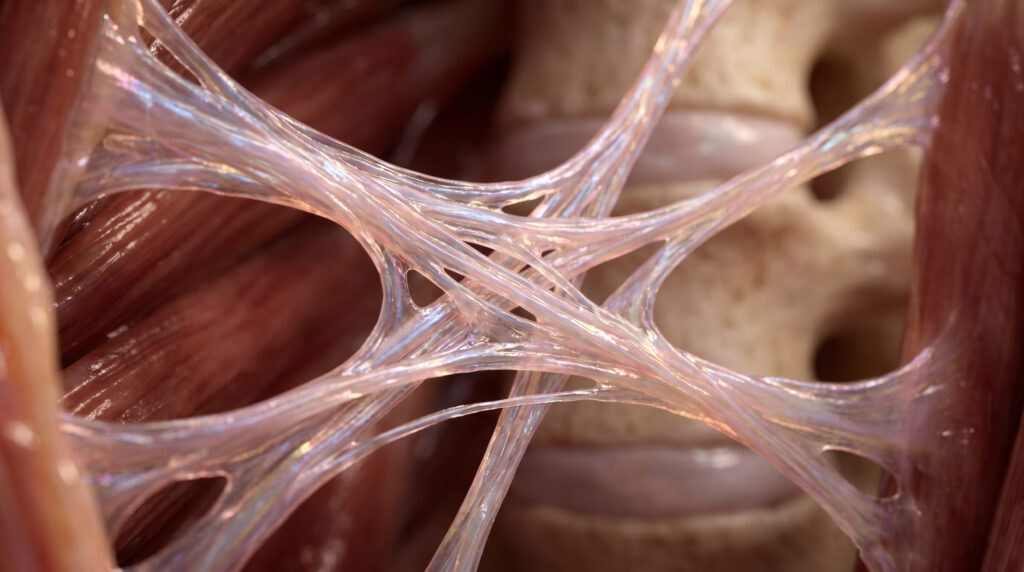
The human frame is not a rigid set of stacked blocks; it is a complex, tension-based suspension system. The “problem” most adults face is not just a curved spine, but tissue adaptation to gravity. Over years, our ligaments, tendons, and fascia lose their “spring” and begin to shorten and stiffen, pulling the skeletal structure into a compressed state. This blog explores how we can shift from “holding” a posture to “remodeling” the very tissues that hold us.
The Science of Viscoelasticity
To understand height, we must understand the difference between Elasticity and Viscoelasticity.
Elasticity: Like a rubber band, the tissue stretches and immediately snaps back.
Viscoelasticity: Like memory foam or specialized polymers, these tissues exhibit time-dependent strain. If you apply a specific, consistent tension over time, the tissue actually reshapes and “re-sets” its resting length.
The human body’s connective tissues—specifically the ligaments surrounding the vertebrae and the tendons near the long bone epiphyses—are viscoelastic. They are composed primarily of Collagen (for strength) and Elastin (for flexibility). When these tissues are subjected to mechanical loading (or lack thereof), they undergo a process called Mechanotransduction. This is where your cells sense physical tension and convert it into a biological response, such as fiber lengthening or reinforcement.
The Extracellular Matrix (ECM) and Interstitial Space
The secret to true elongation lies in the Extracellular Matrix (ECM). This is the non-cellular component present within all tissues and organs. In the context of height:
Hydration & Space: The ECM contains proteoglycans that hold water. When connective tissues are tight and compressed, this “fluid” is squeezed out, leading to disc thinning and joint compression.
Structural Integrity: By increasing the elasticity of the ECM through controlled tension, we allow for more space between the joints. This isn’t just “straightening” a curve; it is physically expanding the gaps that gravity has spent decades closing.
The Age Divide (Under 24 vs. 30+)
The Biological Window (Under 24): For those under 24, the primary mechanism for height is the Epiphyseal Plate (Growth Plate). At this stage, tissue elasticity is at its peak. By stretching the tissues surrounding these plates, we reduce the “compressive clamping” effect. This allows the chondrocytes (cartilage cells) within the plate to expand and ossify more freely, leading to genuine bone elongation.
The Structural Window (30+): Once the growth plates have fused, the focus shifts to Fascial Remodeling. While the bones themselves are no longer lengthening via the growth plate, the “connective tissue sheath” that wraps around your entire skeletal system can still be lengthened. By targeting the elasticity of the ligaments that support the spinal column and the major joints of the legs, we can achieve “decompression elongation”, reclaiming height that was previously lost to tissue stiffness and gravity induced shrinkage.
The Mechanics of Targeted Elongation
Understanding that tissue is viscoelastic is only half the battle; the other half is knowing how to apply the correct Mechanical Tension. Not all stretching is created equal. To achieve remodeling of the connective tissue and facilitate elongation, the tension must be:
Consistent: Short bursts of stretching only affect the muscles. Long-duration, low-load tension is required to signal the fibroblasts (cells that produce collagen) to reorganize the tissue matrix.
Targeted: General yoga or gym stretching often misses the deep ligamentous structures surrounding the growth plates and the spinal vertebrae.
Decompressive: Most “height exercises” are done while standing, which means you are fighting gravity. Effective elongation happens best when the axial load of gravity is removed or reversed.
How CorHeight Addresses the Point?
This is where the distinction between a “posture strap” and the CorHeight System becomes clear.
CorHeight is designed as a Mechanical Loading System that targets the specific tissue elasticity discussed in earlier.
By applying precise tension to the tissues surrounding the epiphyses and the vertebral column, it triggers the Mechanotransduction process. In younger users (under 24), this reduces the physical pressure on the growth plates, creating an “open path” for bone elongation. For users in their 30s and beyond, the system focuses on Decompression Elongation, stretching the shortened ligaments and remodeling the fascia to reclaim the vertical space between the joints that has been lost to years of gravitational compression.
Conclusion: Redefining the Human Frame
The journey to maximizing height is a biological endeavor, not just a cosmetic one. By shifting our focus from the “rigidity” of bone to the “elasticity” of connective tissue, we unlock a new dimension of physical potential. Whether you are still within your natural growth window or looking to restore and expand your adult stature, the key lies in the science of Tissue Remodeling. You are not stuck with the height gravity gave you; you are capable of reshaping the very fibers that hold you together.
Scientific References & Further Reading
To maintain our professional authority, we reference the foundational principles of biomechanics and tissue biology.
Mechanotransduction in Connective Tissue: Ingber, D. E. (2006). Cellular mechanotransduction: putting all the pieces together again. FASEB Journal.
[Focus: How physical tension turns into biological growth].
Viscoelastic Properties of Ligaments: Frank, C. B. (2004). Ligament structure, physiology and function. Journal of Musculoskeletal and Neuronal Interactions.
[Focus: The ability of ligaments to stretch and reshape].
Mechanical Effects on Skeletal Growth: Stokes, I. A. (2002). Mechanical effects on skeletal growth and remodeling. Journal of Musculoskeletal and Neuronal Interactions.
[Focus: The Hueter-Volkmann Law and how reducing compression facilitates elongation].
Spinal Decompression and Mobility: Heneghan, N. R., et al. (2011). Thoracic spine extension mobility in young adults: influence of subject position and spinal curvature. Journal of Orthopaedic & Sports Physical Therapy.
[Focus: Proof that unloading the spine in specific positions increases length and range of motion].